
Dear Farmer Friends,
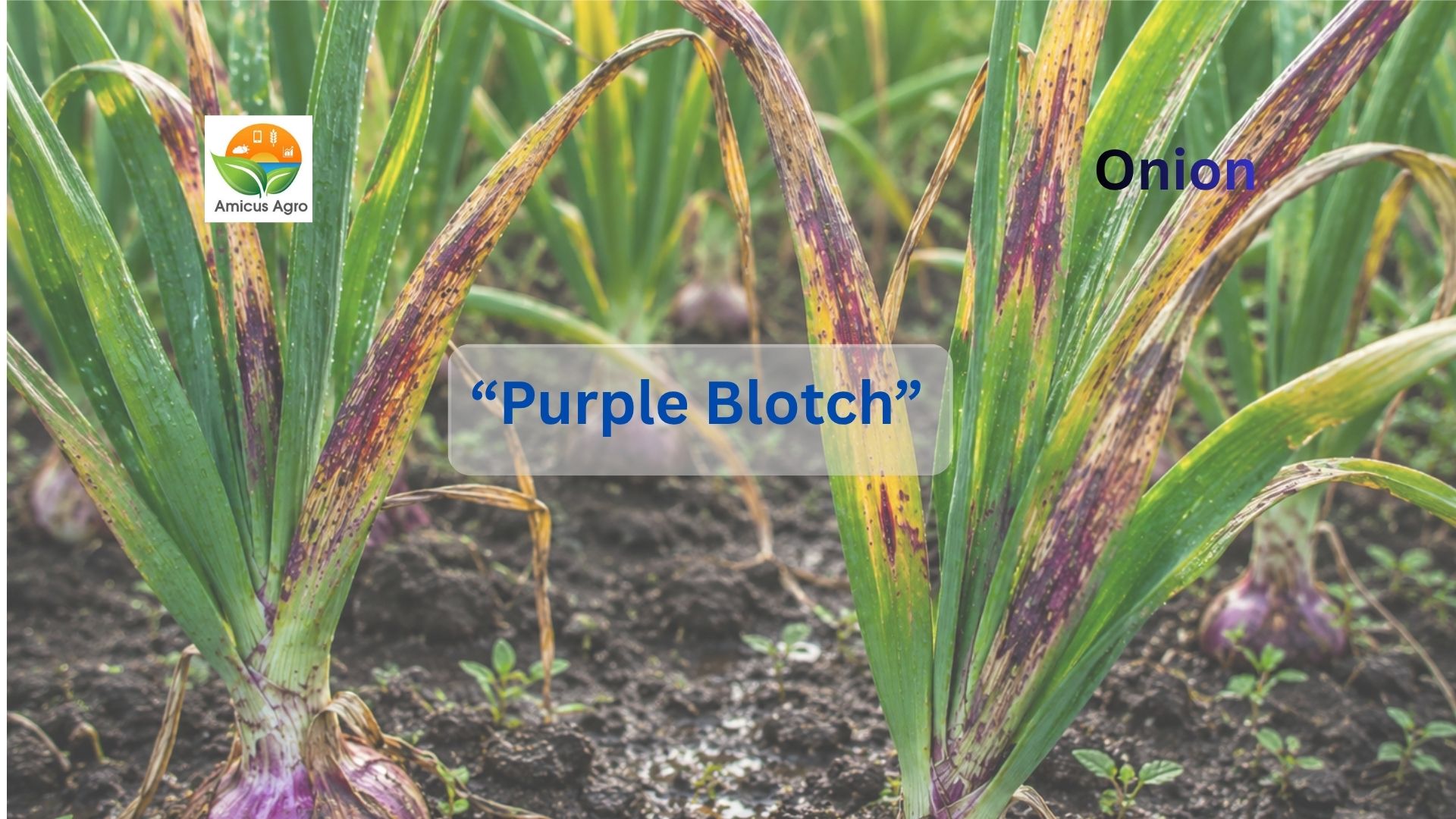
Currently, a major problem is being observed in onion crops. Many farmers are reporting that onion leaves are turning yellow and drying up starting from the tips downward. If you are noticing the same condition in your field, it could be ‘Purple Blotch’ (also known as Jambhala Karpa).
What is ‘Purple Blotch’?
It is a highly destructive fungal disease affecting onion crops caused by the fungus Alternaria porri. In local terminology, farmers commonly refer to it as Karpa or Jambhala Karpa.
Disease Identification and Symptoms
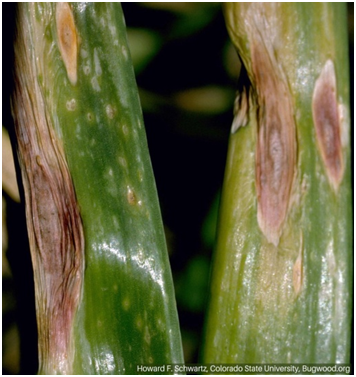
- Spots on Leaves: Initially, small, pale white, or water-soaked spots appear on the onion leaves.
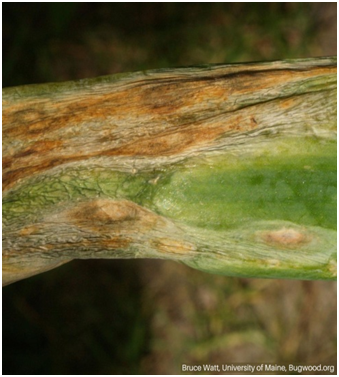
- Purple Rings: Within a few days, these spots enlarge, turning dark purple or brown at the center, surrounded by a yellowish halo.
- Drying of Leaves: As the disease severity increases, the leaves begin to dry and scorch from the tip downward.
- Breaking of Leaves: The leaves become weak at the points where purple spots develop, causing them to bend and fall over to the ground.
.
🌧️ Why Does This Disease Spread Rapidly? (Favorable Environment)
- Continuous cloudy weather and unseasonal rainfall.
- High atmospheric humidity (moisture) above $80\% \text{ to } 90\%$.
- Heavy morning dew and sudden temperature fluctuations.
Impact on Crop and Yield
When leaves break and dry up, the crop’s photosynthesis (food production) process slows down significantly. As a result, bulb development is impaired, leaving the onions small in size (Galti/Golwa). Additionally, such infected onions do not last long during storage and tend to rot quickly.
Management and Preventive Measures
To control this disease, an integrated management approach is essential.
1. Preventive Measures
- Crop Rotation: Rotate your crops regularly; avoid planting onions in the same field year after year.
- Proper Spacing: Maintain appropriate spacing between plants during transplantation to ensure good air circulation.
- Drainage: Ensure proper drainage so that water does not log in the field.
- Avoid Excess Nitrogen: Limit the overuse of nitrogenous fertilizers (e.g., Urea), as it makes the leaves overly succulent and more susceptible to disease.
2. Chemical Spraying
Fungicide application is necessary at the first appearance of symptoms.
- Based on expert recommendations, apply suitable fungicides such as Mancozeb, Tebuconazole, or Azoxystrobin + Tebuconazole at prescribed dosages.
Crucial Tip: Onion leaves have a smooth, waxy surface. Therefore, always add a high-quality Sticker / Spreader to the spray solution to ensure proper adherence.
Introducing Colicab-Cu
If traditional fungicides are failing to keep the blight under control, Colicab-Cu—developed through our modern research at Amicus—will serve as an ultimate solution for your crop!
How COLICAB-CU Works:
- Direct Attack on Fungal Cells: Its nano-components easily penetrate fungal cells and completely block their ability to synthesize food.
- Stops Reproduction: It acts on the DNA of the fungus, destroying its ability to produce new spores, thereby halting the spread of the disease on the spot.
- Restores Leaf Freshness: By controlling the blight, it helps keep onion leaves lush green, ensuring uniform and robust onion bulb growth.
Recommended Dosage & Application:
- 💧 Dosage: $2\text{ ml}$ per liter of water (or $800\text{ ml}$ per acre).
- ⏰ Best Time to Spray: Always spray during early morning or late evening. Avoid spraying in intense direct sunlight.
Conclusion
Although Purple Blotch in onions appears severe, it can be completely managed through field hygiene, early detection, and modern solutions like Colicab-Cu. With proper care, you can secure a healthy and high-yielding onion crop!